Des Moines
On the RoadDes Moines is a pivotal waypoint in Sal Paradise’s journeys across the United States: in 1947, it is where exhaustion briefly loosens his sense of identity, and on a later crossing it returns as a remembered landmark within Dean Moriarty’s breakneck drive east. The city is neither a destination nor a simple stopover. Its railroad district, hotel room, and surrounding roads make it a threshold where the imagined West becomes physical travel, and where a familiar place can measure how much the traveler and the country around him have changed.
The 1947 crossing
Sal reaches Des Moines at dawn after traveling through the night in a truck. The driver stops for breakfast, so Sal continues into town with two University of Iowa students, riding in their new, comfortable car and listening to them talk about exams. The change of vehicle and company gives the entrance a quiet contrast: after the night’s long-distance ride, the orderly conversation of students belongs to a settled routine that Sal is passing through rather than joining.
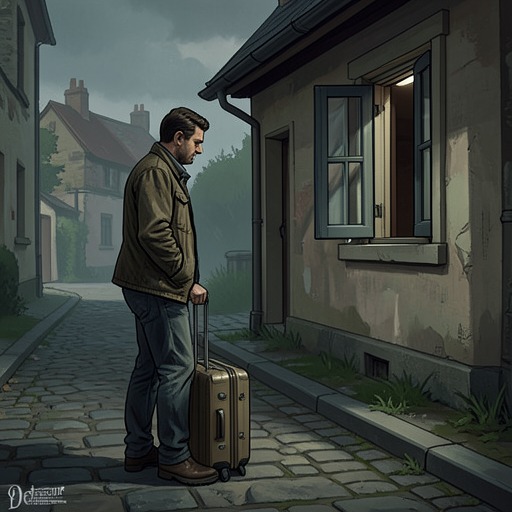
Wanting a full day’s sleep, Sal first tries the Y, which has no room. He wanders toward the railroad tracks and finds a gloomy old hotel near the locomotive roundhouse. He sleeps on a clean, hard white bed beneath yellow window shades, with the smoky rail yards outside and dirty remarks carved into the wall beside his pillow. The room is a practical refuge, but its setting keeps the movement of the road close: trains and their sounds remain just beyond the window, while Sal lies still for a day.
A moment of estrangement
When Sal wakes as the sun reddens, the unfamiliar hotel room produces a brief but profound break in self-recognition. For about fifteen seconds, looking at the cracked high ceiling and hearing steam outside, the old hotel’s wood creak, and footsteps overhead, he does not know who he is. He is not frightened; he feels instead like a stranger whose entire life has become a haunted one. The moment makes travel more than a sequence of miles: in Des Moines, being far from home turns into the sense of being separated from one’s own identity.
Sal interprets the episode through the city’s position in his journey. He is halfway across the country, at a dividing line between the East of his youth and the West of his future. That language makes Des Moines a geographic and psychological hinge. The red afternoon does not resolve the uncertainty of the crossing, but gives it a particular place and hour; after the moment passes, Sal picks up his bag, bids farewell to the hotelkeeper, and goes out to eat.
The road resumes
The meal—apple pie and ice cream—registers as a small improvement in Sal’s fortunes as he moves deeper into Iowa: the pie seems bigger and the ice cream richer. He sees girls coming home from high school, but tells himself he has no time to linger over them and promises himself a good time in Denver. His attention is already oriented toward the people waiting there, including Carlo Marx, Dean Moriarty, Chad King, Tim Gray, Marylou, Ray Rawlins, Babe Rawlins, the Bettencourt sisters, and Roland Major. The city’s ordinary afternoon is thus framed by anticipation of the next gathering, and Sal hurries out rather than treating Des Moines as a place to settle.
His departure begins through another sequence of rides. A man driving a tool-filled truck gives him a lift up a long hill; a farmer and his son then take him toward Adel. Under an elm near a gas station, Sal meets Eddie, a thirty-year-old Irishman heading to Denver to see a girl and begin a new life. Eddie has no travel bag, only a toothbrush and handkerchiefs, and looks like an unlikely companion. Sal nevertheless accepts his proposal that they hitchhike together, drawn to the possibility of human friendship while traveling alone.
Return as a measure of change
On a later journey east with Dean Moriarty, Des Moines reappears through memory. After a fast drive across Iowa, Sal recognizes Newton as the place where he had taken a dawn walk in 1947; the route then carries the party through Davenport and across the Mississippi into Illinois. Des Moines is not the scene of the later police stop, but the earlier city belongs to the same recalled Iowa passage, and its associations make the crossing feel less like unmarked distance than a return through accumulated experience.
The difference between the two journeys is stark. In 1947 Sal reaches Des Moines worn down enough to sleep through the day and wake unsure of himself; later, he travels in a Cadillac driven by Dean, whose speed and exhaustion make the road dangerous. The remembered Iowa landscape changes from a place of solitary pause into part of a high-speed passage toward Chicago. The recurrence gives the city a quiet structural role: it anchors the vastness of cross-country travel in specific stops and memories, while showing how the road’s promise of freedom remains entangled with fatigue, risk, and dependence on other people.